


ISSN : 2277-6001
EISSN :



MHAPANKAR S.A.1*, BARVE P.M.2, SHARMA R.K.3, CHATTERJI A.D.4, BORICHA B.G.5
1Department of Obstetrics and Gynecology, MGM Medical College, Kamothe, Navi Mumbai- 410209, MS, India.
2Department of Obstetrics and Gynecology, MGM Medical College, Kamothe, Navi Mumbai- 410209, MS, India.
3Department of Obstetrics and Gynecology, MGM Medical College, Kamothe, Navi Mumbai- 410209, MS, India.
4Department of Obstetrics and Gynecology, MGM Medical College, Kamothe, Navi Mumbai- 410209, MS, India.
5Department of Obstetrics and Gynecology, MGM Medical College, Kamothe, Navi Mumbai- 410209, MS, India.
* Corresponding Author : sabrina.mhapankar@yahoo.com
Received : 23-01-2013 Accepted : 07-02-2013 Published : 31-12-2013
Volume : 2 Issue : 1 Pages : 4 - 9
World Res J Obstet Gynecol 2.1 (2013):4-9
Conflict of Interest : None declared
The purpose of this study was to evaluate the awareness and attitudes of individuals towards emergency contraception (EC) and whether EC is replacing the mainstream regular contraception. A questionnaire based study having 150 participants was done, which included males and females in the age group of 18 to 45 years, selected randomly from among patients, faculty members and students.Questions were asked to know about the knowledge of EC, its OTC availability, source of information, side effects, timing of use, past and future use, cost factor and effects of its easy availability52.6% participants have had unprotected sexual intercourse or contraceptive failure and 30.7% have undergone an abortion in the past. The awareness of emergency contraceptives on the campus is good (77.3%). However the knowledge of correct timing of use (34.7%) and side effects (31.3%) is poor. Media is the source of information for 55.33% of participants but advertise-ments do not give accurate information. 21.3% have used emergency contraceptives in the past, out of which 93.7% have found it to be effec-tive. 64% would like to use it in the future. 45.3% would like to consult a doctor before taking it. 34% would like to discontinue regular contra-ception. EC has proved to be a boon but has increased risky sexual behavior and has discouraged the use of regular contraception. Counsel-ing has to be undertaken to prevent its misuse. It should be stressed that EC is a backup method and should be offered along with regular contraception.
Emergency contraception (EC), over the counter (OTC)
Emergency contraception is contraception taken after unprotected sexual intercourse to prevent pregnancy. It includes emergency contraceptive pills and intrauterine devices. It is intended for occasional and emergency use, and not as an ongoing method of contraception. Emergency contraceptives can be used in case of unprotected sexual intercourse, rape, incest or in the event of contraceptive failure such as condom rupture or slippage of diaphragm. Emergency Contraceptive (EC) pill is often called the ‘morning after’ pill, but this term is misleading because it can be taken within 72 hours of intercourse, and not just the ‘morning after’.
India with its population crossing one billion is in urgent need of population control measures. In India, 78% conceptions each year are unplanned and 25% are unwanted [1] . The number of abortions is over 11 million per year, of which 6.7 million are induced. There are 10-11 illegal abortions for each legal abortion. This accounts for 15,000 to 20,000 abortion-related deaths annually and a high associated morbidity, almost all of which is preventable [2] . Inspite of the availability of a wide range of contraceptives, its coverage still continues to be poor in India, due to lack of appropriate knowledge, fear of side effects, or because of reluctance to use methods linked with coitus (barriers like condom or diaphragm). Hence, there is exposure to unprotected sex and thereby a need for use of emergency contraception, to avoid ill effects of pregnancy termination. This emphasizes the need for strengthening this additional ‘back-up’ method of emergency contraception.
In 2002, India’s Reproductive and Child Health Programme introduced emergency contraception. On August 31, 2005, levonorgestrel only pill was made available over the counter as emergency contraceptive. Today, EC pills are easily available in pharmacies to all those who need it, at affordable cost. Commercial interests have led to marketing of the product on a large scale, in the form of television advertisements and printed media. This has led to an increased awareness of emergency contraceptives among the populace. In the light of these recent advances, it is extremely important to evaluate the current status of emergency contraception in India and to know whether the media coverage is adequate for correct self-administration of the pills.
This study was undertaken to find out whether over the counter availability of emergency contraceptive pills has resulted in increase in the awareness levels about the same and to determine if easy availability has led to increased usage of emergency contraceptive pills by women.
The study was carried out among individuals on MGM College and Hospital campus, Kamothe. This study population included patients, faculty members, nursing staff and students of medical, engineering and management colleges. This provided a heterogeneous population with varying levels of knowledge and awareness, ranging from doctors to uneducated patients, most importantly consisting of the young student population who are most likely to use emergency contraception, thus making it the ideal population group to carry out this study. The questionnaire-based study carried out for this purpose accomplished the aforementioned objectives by asking relevant questions to test and judge the awareness and attitudes of individuals towards emergency contraception.
There have been very few studies in India on EC after its availability over the counter. Hence, this study was undertaken to evaluate the current status of emergency contraception, which is the last chance a woman truly deserves.
The data used for this research project was obtained from a cross sectional questionnaire based study carried out on the campus of MGM Medical College, Kamothe, and Navi Mumbai. The study included 150 participants. Inclusion criteria comprised of males and females between the age group of 18 to 45 years present on the campus and giving informed consent. These participants were randomly selected from among patients attending OPD clinics in MGM hospital, faculty members and students of medical, nursing, engineering and management colleges. The questionnaire was pretested on a sample of 10 consenting subjects on the college campus, who answered and returned the questionnaire.The completed questionnaires were then studied and some questions were refined. Each participant was informed about the objectives of the study, the nature of his/her participation, the risks and benefits and confidentiality of the study. Informed consent was taken from each participant. None of the participants refused to participate in the study. An anonymous, self-administered, prestructured questionnaire was given to each participant. The questionnaire consisted of 20 questions, to test the awareness, attitudes towards emergency contraception, and to give background data and relevant information. Anonymity ensured confidentiality and assured the participants that the information collected could not be traced back to them. The data collected with the help of questionnaire was analyzed using Statistical Package for Social Sciences. Descriptive statistics were analyzed using percentages. In order to assess awareness, 5 questions were used. Each of these questions were given weightage according to their importance in the study.
• Que. 2: Which method of family planning have you heard of?’ had a total weightage of 7 marks, each option carrying 1 mark.
• Que. 5: Have you heard about a tablet (pill) which can be taken after unprotected sexual intercourse or a contraceptive failure (like condom slippage or forgot to take OC pill) to prevent unwanted pregnancy?’ The answer ‘yes’ carried 3 marks.
• Que. 8: Are you aware that emergency contraceptive pill (e.g. I pill) is available in the pharmacies over the counter? ‘The answer ‘yes’ carried 2 marks.
• Que. 15: Are you aware of any side effects of the pill which prevents you from taking it?’ The answer ‘yes’ carried 3 marks.
• Que. 16: According to you, when is I pill to be taken?’ The correct answer carried 5 marks.
Thus, awareness was assessed using a 20 mark scale. The marks were then converted to percentages. The awareness was assessed as:
75% and above -excellent
60-75% - good
45-60%- average
25-45%- poor
0-25%- very poor
Attitudes were assessed using 4 questions, each carrying 1 mark.
• Que. 1: Do you believe in family planning? The answer ‘yes’ carried 1 mark.
• Que. 13: Would you like to use emergency contraception in the future, if required? The answer ‘yes’ carried 1 mark.
• Que. 14: Would you like to consult a doctor before taking emergency contraception? The answer ‘yes’ carried 1 mark.
• Que. 17: Would you like to discontinue regular contraception since emergency contraception is available? The answer ‘no’ carried 1 mark.
Thus attitudes were assessed using a 4 mark scale, and marks were converted to percentages.
100% - strongly agree
75% Agree
50% Neutral
25% Disagree
0% completely disagrees
Other questions were assessed according to age, sex, education and marital status wherever applicable, using percentages. Chi-square test was used to measure the association.
Demographic Characteristics
A total of 150 individuals participated in this study. Out of these, 99(66%) are females and 51(34%) are males. 100(66.66%) belong to the age group of 18-26 years, 35(23.33%) to 27-36 years and 15(10%) to the age group of 37-45 years.68(45.3%) are married, 82(54.7%) are single. 23(15.3%) are educated upto the primary level, 42(28%) upto the higher secondary level, 55(36.7%) are graduates and 30(20%) are post-graduates.
138(92%) participants believe in family planning, while 12(8%) do not.
135 are aware of barrier methods like condom as a method of family planning, 95 know about copper T, 123 know about oral pills, 53 know about injectables, 50 know about natural methods, 106 know about vasectomy and 59 about tubectomy [Table-1] . 6 know of only 1 method of contraception, 29 know of 2 methods, 25 know of 3 methods, 26 know of 4 methods, 6 know of 5 methods, 4 know about all except one, and 48 know about all methods of contraception.
A total of 57(38%) participants use contraception, out of which 70.2% are married and 29.8% are single. Out of the 93(62%) not using any method of contraception, 30.1% are married [Table-2] .
In case of contraceptive failure or unprotected intercourse, 22.7% would consult a doctor (A), 20% would undergo MTP (B), 42% would take an I-pill (C) while 14.7% would continue with the pregnancy (D), while 0.7% would opt to consult a doctor as well as take an I- pill [Table-3] .
79(52.6%) have had unprotected sexual intercourse or contraceptive failure in the past.
39.5% females and 78.4% males have had unprotected intercourse/ contraceptive failure in the past [Table-4] .
46(30.7%) have had an abortion in the past [Table-5] .
[Table-6] shows that 84.8% females and 62.7 % of males have heard of I pill.
[Table-7] shows that 21.7% of primary-educated participants, 76.2% of HSC passed participants, 92% of graduates and 93.3% of post graduates have heard of I pill. 116(77.3%) had heard of i-pill while 34(22.7%) had never heard of it before.
A total of 37(24.66%) participants had heard about I pill from their doctor (A), 19(12.66%) had heard of it from their friend/ relative (B) and 83(55.33%) had heard of it from television or printed advertisements. (C) (34 participants were not applicable since they had never heard of I pill).
Information from Advertisements- 39(26%) participants think that advertisements give enough information while 77(51.3%) think that they do not, 34 participants being not applicable [Table-8] .
• Over-the-Counter Availability: 85(56.7%) participants are aware that emergency contraceptives are available over the counter.
• Awareness of side-effects: 47(31.3%) are aware of its side effects. 52(34.7%) know about the correct timing of its use.
32(21.3%) have used emergency contraceptives in the past, out of which 30 have found it to be effective. 96(64%) said that they would like to use it in the future. 68(45.3%) would like to consult a doctor before taking it. 51(34%) said that they would like to discontinue regular contraception since emergency contraception is available.
93(62%) think that over the counter availability is a boon. 16 think that cost factor is a problem, while 58 know of emergency contraception but are not aware of its cost. 103(68.7%) think that availability of emergency contraception has increased risky sexual behavior [Table-9] .
The following table shows awareness according to the level of education:
[Table-10] shows that 19.3% participants have very poor awareness, 30.7% have poor awareness, 24.7% have an average level of awareness, 18% have good and 7.3% have very good awareness.
78.3% and 21.7% of participants educated upto primary level have very poor and poor level of awareness respectively. None of them have average or good levels of awareness.
21.4%, 50%, 26.2% and 2.4% of those having higher secondary education have very poor, poor, average and good level of awareness respectively. None of them have a very good level of awareness.
3.6%, 32.7%, 36.4%, 18.2% and 9.1% of graduates have very poor, poor, average, good and very good levels of awareness respectively.
6.7%, 20%, 53.3% and 20% postgraduates have poor, average, good and very good level of awareness respectively. None of the postgraduates have a very poor level of awareness.
Using the chi-square test, it is observed that a significant association exists between level of awareness and education.
The following table shows attitudes with respect to different levels of education:
[Table-11] It is observed that 8% have a strongly negative attitude, 19.3% have a negative attitude, 13.3% are neutral, 40% have a positive attitude and 19.3% have a strongly positive attitude towards use of emergency contraceptives.
• A majority of the primary educated participants (56.5%) have a negative attitude.
• A majority of the higher secondary educated participants(57.1%) have positive attitude.
• A majority of the graduates (32.7%) have positive attitude.
• A majority of the post graduates (43% and 43%) have positive and strongly positive attitudes respectively.
Using the chi-square test, it is observed that a significant association exists between attitudes and education.
According to the present study, 92% participants believe in family planning. Knowledge level of various methods of contraception is good. However, 30.1% married people do not use any method of contraception. 77.3% of participants have heard of emergency contraceptives (EC), which are more than similar studies carried out in Chandigarh (7.3%) [3] , Kathmandu (66%) [4] , Uganda [5] , Cameroon (63%) [6] , but less than that in developed countries such as Finland (98%) [7] . The high awareness levels in the present study could be due to the fact that a majority of participants were medical students or doctors or paramedical workers. More females (84.8%) than males (62.2%) had heard about EC, as opposed to the study done in Nepal where more males than females had heard of the same [4] .
Awareness of EC has increased from 11.2% according to a Chandigarh study among educated women done in 2003 [8] , to 77.3% according to the present study done in 2010. This shows that awareness of emergency contraceptives in India has increased sevenfold in the past 7 years. This can be attributed to the intense campaigning and advertisements about emergency contraceptives in the past few years.
The source of information for 55.33% of participants of this study was television or printed advertisements. However, only 26% think that advertisements give adequate information. This stresses the need for a more comprehensive approach to campaigning of EC so that correct information reaches the users of EC.
56.7% are aware of the over-the-counter (OTC) availability of EC. 62% think that OTC availability is a boon which is contradictory to the opinions of students of Uganda where 63.4% were not in favor of OTC use [5] .
Awareness of side effects of EC in this study was 31.3% which is much less than that in Chandigarh (88.9%) [3] . Correct timing of use of EC is known to only 34.7% of the participants, better that reported in Chandigarh (14.2%) [3] , much less than that among medical students in Delhi (95%) [9] . This finding further emphasizes the need for provision of adequate information regarding EC.
21.3% have used EC in the past, and 64% would like to use it in the future, which is slightly less than that reported in a study among educated working women in Chandigarh (81%) [8] . This finding shows that there is need to further encourage the use of EC.
34% say that they would like to discontinue regular contraception in favor of EC, and 68.7% think that OTC availability will increase risky sexual behavior, which corresponds to the findings of a similar study done in Mangalore city [10] .
It is observed that a significant association exists between awareness of EC and education. 59.3% participants have a positive attitude towards EC. A significant association exists between attitudes towards EC and education. Thus it necessitates the need to increase the levels of awareness of EC among uneducated people.
The purpose of this study was to evaluate the awareness and attitudes of individuals towards emergency contraception (EC), and effects of its over-the-counter (OTC) availability and its promotion by the media. A questionnaire-based study was done on the campus of MGM Medical College, Kamothe. The participants included males and females in the age group of 18 to 45 years and giving informed verbal consent, selected randomly from among patients attending OPD clinics in MGM hospital, faculty members and students of medical, nursing, engineering and management colleges. Anonymity of the questionnaire ensured confidentiality. Questions were asked to know about the contraceptive practices, knowledge of EC and its OTC availability, source of information, its side effects, timing of its use, past and future use of EC, cost factor and whether easy availability has discouraged use of regular contraception and increased risky sexual behavior. The data was analyzed and marks were given to determine the level of awareness and attitudes.
It was foundd that (52.6%) participants have had unprotected sexual intercourse or contraceptive failure in the past and 30.7% have had an abortion in the past. The awareness of emergency contraceptives on MGM Medical College campus is good (77.3%). However the knowledge of correct timing of its use (34.7%) and its side effects (31.3%) is poor. Media is the source of information for 55.33% of participants. Advertisements do not give accurate information about EC. 32(21.3%) have used emergency contraceptives in the past, out of which 30 have found it to be effective. 96(64%) said that they would like to use it in the future. 68(45.3%) would like to consult a doctor before taking it. 51(34%) said that they would like to discontinue regular contraception since emergency contraception is available. Over the counter availability of EC has proved to be a boon. However, it has significantly increased risky sexual behavior and has discouraged the use of regular contraception. A significant association exists between level of awareness and attitudes, and level of education.
Promotional measures taken by the government have significantly improved the awareness and attitudes towards emergency contraception. Efforts have to be made to provide more accurate information about EC, and counseling has to be undertaken to prevent misuse of EC.
Promotional measures taken by the government have significantly improved the awareness and attitudes towards emergency contraception but with still further scope for improvement. Efforts have to be made to provide more accurate information about EC.The fact that EC is a backup method has to be stressed. Women should be offered regular contraception and back up method of emergency contraception in the same sitting so that both go hand in hand. It is necessary to frame effective policies for inclusion of EC in mainstream contraceptives, without discouraging the use of regular contraception. Counseling has to be undertaken to prevent misuse of emergency contraception.
The dedicated services of all health care workers along with the efforts by the government would definitely go a long way to propagate EC to prevent unwanted pregnancies and fulfill our broader aim of†have one adopt oneâ€.
Indian Council of Medical Research, short term studentship 2010 project.
[1] National Family Health Survey (1995-96) Family Planning and Contraceptive Use, International Institute of Population Sciences.
» CrossRef » Google Scholar » PubMed » DOAJ » CAS » Scopus
[2] Chhabra R., Nuna S. (1993) Abortion in India: An Overview, Veerandra Publishers, New Delhi,129-44.
» CrossRef » Google Scholar » PubMed » DOAJ » CAS » Scopus
[3] Puri S., Bhatia V., Swami H.M., Singh A., Kaur A.P. (2007) Indian J. Med. Sci., 61(6), 338-46.
» CrossRef » Google Scholar » PubMed » DOAJ » CAS » Scopus
[4] Ramesh Adhikari (2006) BMC Women's Health, 9, 27.
» CrossRef » Google Scholar » PubMed » DOAJ » CAS » Scopus
[5] Josaphat K. Byamugisha, Florence M. Mirembe, Elisabeth Faxelid and Kristina Gemzell-Danielsson (2006) Afr. Health Sci., 6(4), 194-200.
» CrossRef » Google Scholar » PubMed » DOAJ » CAS » Scopus
[6] Eugene J. Kongnyuy, Pius Ngassa, Nelson Fomulu, Charles Shey Wiysonge, Luc Kouam and Anderson S. Doh (2007) BMC Emerg. Med., 7, 7.
» CrossRef » Google Scholar » PubMed » DOAJ » CAS » Scopus
[7] Kobra Falah-Hassani, Elise Kosune, Rahman Shiri, Arja Rimpelä (2007) BMC Public Health, 7, 201.
» CrossRef » Google Scholar » PubMed » DOAJ » CAS » Scopus
[8] Takkar N., Goel P., Saha P.K., Dua D. (2003) Indian J. Med. Sci., 59(4), 143-49.
» CrossRef » Google Scholar » PubMed » DOAJ » CAS » Scopus
[9] Sharma J.B., Bahadur A., Chadha S., Mehta S., Mittal S. (2009) Indian J. Med. Sci., 63, 115-7.
» CrossRef » Google Scholar » PubMed » DOAJ » CAS » Scopus
[10] Jain K., Swathi J. (2010) Indian J. Sex. Transm. Dis., 31(1), 54-5.
» CrossRef » Google Scholar » PubMed » DOAJ » CAS » Scopus
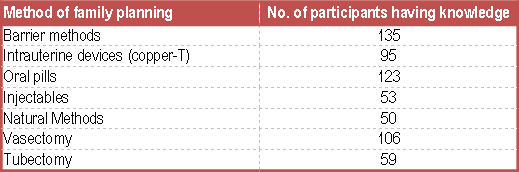 | <i>Table 1- Methods of Contraception</i> |
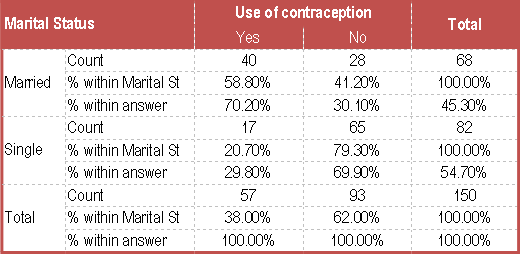 | <i>Table 2- Use of contraception according to marital status</i> |
 | <i>Table 3- Choice of action in case of contraceptive failure/ unprotected intercourse</i> |
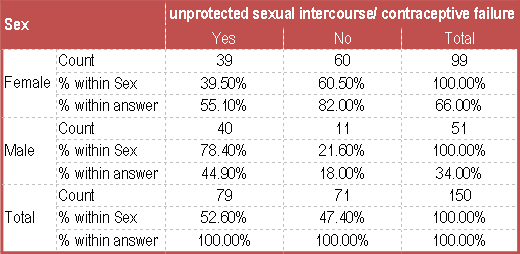 | <i>Table 4- Unprotected sexual intercourse/ contraceptive failure acc. to sex</i> |
 | <i>Table 5- Past Abortions</i> |
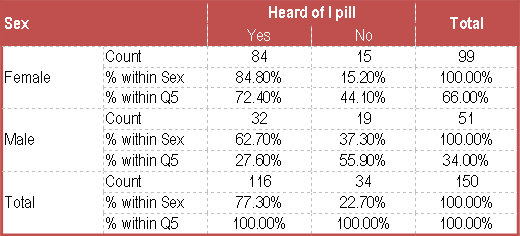 | <i>Table 6- Knowledge of I pill according to sex</i> |
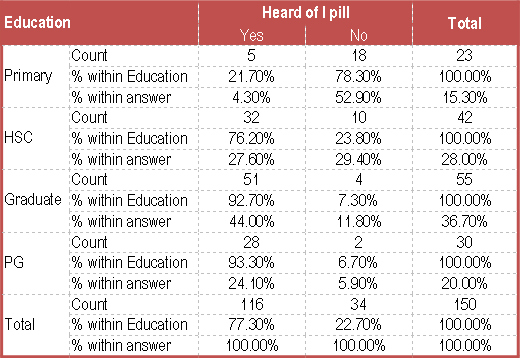 | <i>Table 7- Knowledge of I pill according to education</i> |
 | <i>Table 8- Source of Information</i> |
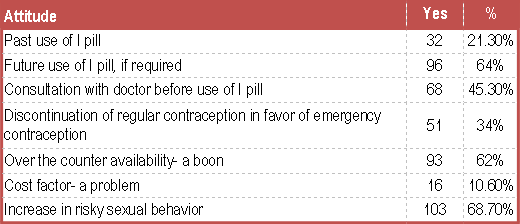 | <i>Table 9- Attitudes towards emergency contraceptives</i> |
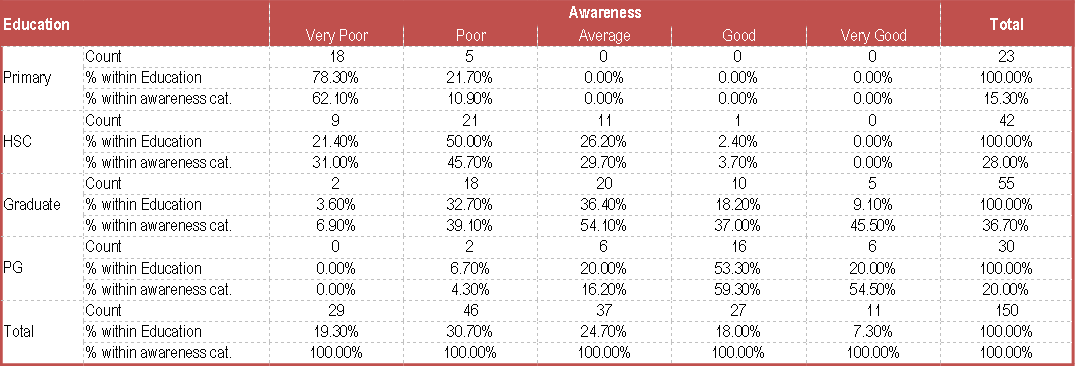 | <i>Table 10- Awareness according to level of education</i> |
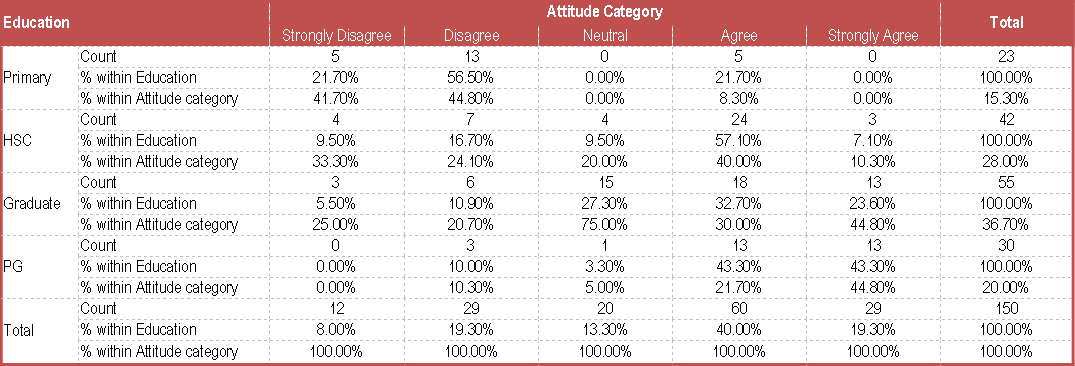 | <i>Table 11- Attitudes according to education</i> |