


ISSN : 0976-8769
EISSN : 0976-8777



GOMASE V.S.1*, CHANGBHALE S.S.2, CHITLANGE N.R.3, SHERKHANE A.S.4
1The Global Open University, Nagaland, India.
2The Global Open University, Nagaland, India.
3The Global Open University, Nagaland, India.
4The Global Open University, Nagaland, India.
* Corresponding Author : gomase.viren@gmail.com
Received : 12-07-2012 Accepted : 09-08-2012 Published : 16-08-2012
Volume : 2 Issue : 1 Pages : 20 - 24
J Toxicol Res 2.1 (2012):20-24
Tityus serrulatus venoms is composed of several toxins that may cause death in human. Tityus serrulatus Venom allergen 5 have significant immunomodulatory ability to enhance immune functions. In this assay we a have predicted potential epitopes from Tityus serrulatus scorpion Venom allergen 5 for peptide vaccine design against envenomation, based on cross protection phenomenon as, an ample immune response can be generated with a single epitope. We found MHC class II binding peptides of Venom allergen 5 are important determinant against the toxic effect. The analysis shows Venom allergen 5 having 212 amino acids, which shows 204 nonamers. In this assay, we have predicted MHC-I binding peptides for 8mer_H2_Db allele (optimal score is 17.016), 9mer_H2_Db allele (optimal score is 15.825), 10mer_H2_Db allele (optimal score is 11.305), 11mer_H2_Db allele (optimal score is 22.813). We also predicted the SVM based MHCII-IAb peptide regions, 123-WTQLYVCNY, 111-ITAVEIPDP, 185-FDETDFSNY (optimal score is 10.938); MHCII-IAd peptide regions, 158- CGSHCKKHN, 107-FTRGITAVE, 91-CDDCRKVEN (optimal score is 20.3); and MHCII-IAg7 peptide regions 36-NTIINLHNK, 13- HTFCKTKNQ, 194-IFNCDFKPE, 70-WDDELAQIA, 95-RKVENFDVG (optimal score is 14.595); which shows potential binders from Tityus serrulatus antigen 5. The method integrates prediction of MHC class I binding proteasomal C- terminal cleavage peptides and nine potential antigenic peptides at average propensity 1.021 having highest local hydrophilicity. Thus a small antigen fragment can induce immune re-sponse against whole antigen. This approach can be applied for designing subunit and synthetic peptide vaccines.
envenomation, Antigenic peptides, MHC-Binders, Nonamers, synthetic peptide vaccines.
Scorpion venoms consist of a complex of several toxins that exhibit a wide range of chemical compositions, biological characteristics and actions, toxicity, and pharmacokinetic and pharmacodynamic properties. Tityus serrulatus is considered the most dangerous scorpion in South America and responsible for most of the fatal cases, commonly known Brazilian yellow scorpion, belongs to the family Buthidae; its venom is extremely toxic. Tityus serrulatus scorpion Venom allergen 5 (antigen 5) is complex of molecules and having significant immunomodulatory capacities of stimulating immune functions. Because of its role in the peripheral nervous system (PNS) and enhancing the neurotransmitters secretion, antigen 5 is capable of exerting a several effects on excitable tissues [1,2] .
This approach is based on the phenomenon of cross-protection [3] hereby an individual affected with a mild toxin possess immunity against similar toxin. Body proteins are necessary for production of immunity in or on all food commodities. Relief from the requirement of a tolerance is established for residues of the drugs or chemicals.
The new paradigm in vaccine design is emerging, following essential discoveries in immunology and development of new MHC class I binding peptides prediction tools [4-6] . MHC molecules are cell surface glycoproteins, which take active part in host immune reactions. The involvement of MHC class I in response to almost all antigens and the variable length of interacting peptides make the study of MHC class I molecules very interesting. MHC molecules have been well characterized in terms of their role in immune reactions. They bind to some of the peptide fragments generated after proteolytic cleavage of antigen [7] . This binding act like red flags for specific antigen and to generate immune response against the parent antigen, thus an antigen subunit can induce immune response against complete venom activities. Antigenic peptides are most suitable for subunit vaccine development because an epitope, can generate ample immune response in large population. MHC-Peptide complexes will be translocated on the surface of antigen presenting cells (APCs). This theme is implemented in designing subunit and synthetic peptide vaccines [8-11] . One of the important problems in subunit vaccine design is to search for antigenic regions in toxin protein [12] that can stimulate T-cells called T-cell epitopes. Fortunately, in literature a large amount of data about such peptides is available. Pastly and presently, a number of databases have been developed to provide comprehensive information related to T-cell epitopes [13-17] .
The antigenic protein sequence of Tityus serrulatus Venom allergen 5 (antigen 5) was analyzed to study the antigenicity [18] , solvent accessible regions and MHC class binding peptides, which allows potential drug targets to identify active sites against venomous activity of the toxin protein.
Antigenicity prediction program results those segments from Tityus serrulatus Venom allergen 5 that are likely to be antigenic by eliciting an antibody response. Antigenic epitopes are determined using the Gomase (2007), Hopp and Woods (1981), Welling (1985), Parker (1986), BepiPred Server (2006) and Kolaskar and Tongaonkar Antigenicity (1990) methods [19-24] .
The important concepts in secondary structure prediction are identified as: residue conformational propensities, sequence edge effects, moments of hydrophobicity, position of insertions and deletions in aligned homologous sequence, moments of conservation, auto-correlation, residue ratios, secondary structure feedback effects and filtering [25,26] .
The MHC binding peptides are predicted by using neural networks trained on C terminals of known epitopes. In this work predicted MHC-Peptide binding is a log-transformed value related to the IC50 values in nM units. RankPep predicts peptide binders to MHC-I and MHC-II molecules from protein sequences or sequence alignments using Position Specific Scoring Matrices (PSSMs). Support Vector Machine (SVM) based method has been used for prediction of promiscuous MHC class II binding peptides. The average accuracy of SVM based method for 42 alleles is ~80%. For determination of potential MHC binders, an elegant machine learning technique SVM has been applied. SVM has been trained on the binary input of single amino acid sequence. In addition, we predicts those MHC-I ligands whose C-terminal end is likely to be the result of proteosomal cleavage [27-33] .
A Tityus serrulatus Venom allergen 5 antigenic sequence (gi-193806572) is 212 residues long as-
ECPALYRRYSKEHTFCKTKNQKCNIKRWGVSQDDRNTI
INLHNKVRNNIALGQDQSGRLPAAGDMLEMEWDDELAQIAQKLA
DQCVFKHDCDDCRKVENFDVGQNIFTRGITAVEIPDPFKSWTQL
YVCNYGPAGNLDDSELYKVDKPCEKCPSNTCCGSHCKKHNKST
SYLGLCDVLNGSGPDFDETDFSNYIFNCDFKPESDCNNKVEGS.
In this assay we predicted the antigenic determinants by finding the area of highest local hydrophilicity. We studied methods Kolaskar and Tongaonkar antigenicity, BepiPred Server, Parker, Emini Surface Accessibility methods [Fig-1] , [Fig-2] , [Fig-3] , [Fig-4] , [Table-1] .
Hopp & Woods hydrophobicity method which predict the locations of antigenic determinants in antigen protein, assuming that the antigenic determinants would be exposed on the protein surface and thus would be located in hydrophilic regions [Fig-5] , its values are derived from the transfer-free energies for amino acid side chains between ethanol and water.
Welling hydrophobicity plot gives value as the log of the quotient between percentage in a sample of known antigenic regions and percentage in average proteins [Fig-6] . The predicted antigenic fragments can bind to MHC molecule is the first bottlenecks in vaccine design.
The Robson and Garnier method has been applied for the prediction of T. serrulatus Venom allergen 5 (antigen 5) secondary structure. Each residue is assigned values for alpha helix (Shown in Red), beta sheet (Shown in Blue) and coils (Shown in Pink) using a window of 7 residues [Fig-7] . Using these information parameters, the likelihood of a given residue assuming each of the four possible conformations alpha, beta, reverse turn, or coils calculated, and the conformation with the largest likelihood is assigned to the residue.
These MHC binding peptides are sufficient for producing the desired immune response. The prediction is based on support vector machine, using amino acids sequence. In this test, we found the MHC-I and MHC-II binding regions [Table-2] , [Table-3] . MHC molecules are cell surface glycoproteins, which actively take part in host immune reactions and involvement of MHC-I and MHC-II in response to almost all antigens. In this study we predicted the binding affinity of T. serrulatus Venom allergen 5, having 212 amino acids, which show several potential nonamers [Table-2] , [Table-3] . For development of MHC binding prediction method, an elegant machine learning technique Support Vector Machine (SVM) has been used. SVM has been trained on the binary input of single amino acid sequence. In this assay we predicted the binding affinity of T. serrulatus Venom allergen 5 sequence having 212 amino acids, which shows 204 nonamers.
We Predicted the SVM based MHCII-IAb peptide regions, 123-WTQLYVCNY, 111-ITAVEIPDP, 185-FDETDFSNY (optimal score is 10.938); MHCII-IAd peptide regions, 158-CGSHCKKHN, 107-FTRGITAVE, 91-CDDCRKVEN (optimal score is 20.3); and MHCII-IAg7 peptide regions 36-NTIINLHNK, 13-HTFCKTKNQ, 194-IFNCDFKPE, 70-WDDELAQIA, 95-RKVENFDVG (optimal score is 14.595); which shows predicted binders from antigen 5 [Table-3] The predicted binding affinity is normalized by the 1% fractil. The MHC-Peptide binding is predicted using neural networks trained on C terminals of known epitopes. In this assay predicted MHC-Peptide binding is a log-transformed value related to the IC50 values in nM units. These MHC binding peptides can decently elicit the proper immune response. Predicted MHC binding regions in an toxin sequence and these are directly associated with immune reactions, we determined the MHC-I and MHC-II binding region.
Gomase method (2007), BepiPred Server, Hopp and Woods, Welling, Parker, Kolaskar and Tongaonkar antigenicity scales were designed to predict the locations of antigenic determinants in S. haematobium 23-kDa transmembrane protein. It shows beta sheets regions, which have higher antigenic response than helical region of this peptide and shows high antigenicity [Fig-1] , [Fig-2] [Fig-3] , [Fig-4] , [Fig-5] , [Fig-6] . In this assay we predicted the binding affinity of T. serrulatus Venom allergen 5 having 212 amino acids, which shows 204 nonamers. We predicted MHC-I binding peptides for 8mer_H2_Db allele (optimal score is 17.016), 9mer_H2_Db allele (optimal score is 15.825), 10mer_H2_Db allele (optimal score is 11.305), 11mer_H2_Db allele (optimal score is 22.813) [Table-2] . MHC molecules are cell surface glycoproteins, which take active part in host immune reactions and involvement of MHC I and MHC II in response to almost all antigens [Table-2] , [Table-3] . Kolaskar and Tongaonkar antigenicity predicted epitopes are the sites of molecules those are recognized by the immune system antibodies for the T. serrulatus Venom allergen 5 (antigen 5), analysis shows antigen 5 epitopes are able to induce desired immune response against envenomation. The region of maximal hydrophilicity is likely to be an antigenic site, having hydrophobic characteristics, because C- terminal regions of venom allergen 5 are solvent accessible and unstructured; antibodies against those regions are also likely to recognize the native protein. During prediction of antigenic determinant site of antigen 5, we found nine antigenic determinant sites in the sequence. The average propensity for the T. serrulatus Venom allergen 5 found is 1.021 [Fig-2] . All residues having above 1.0 propensity are always potentially antigenic [Table-1] . The predicted segments in toxin protein are 39-INLHNK-44, 58-RLPAAG-63, 74-LAQIAQKLADQCVFKHDCDDCRKV-97, 111-ITAVEIPDP-119, 123-WTQLYVCNYG-132, 142-LYKVDKPCEKC-152, 154-SNTCCGSHCKKH-165, 169-TSYLGLCDVLNG-180, 192-NYIFNCD-198. Fragments identified through this approach supposed to be high-efficiency binders, which is a much percentage of their molecules are directly involved in binding as compared to larger molecules.
This method will be applicable in cellular immunology, Vaccine design, immunodiagnostics, immunotherapeutics and molecular understanding of autoimmune susceptibility. T. serrulatus Venom allergen 5 (antigen 5) sequence contains multiple antigenic components to direct and empower the immune system to protect the host against envenomation. MHC molecules are cell surface proteins, which take active part in host immune reactions and involvement of MHC class in response to almost all antigens and it give impacts on specific sites. Predicted MHC binding regions acts like red flags for specific antigen and generate immune response against complete venom toxin. The method integrates prediction of peptide MHC class binding; proteosomal C terminal cleavage and potential antigenic epitope prediction. This theme is implemented in designing subunit and synthetic peptide vaccines.
MHC-Major Histocompatibility Complex, SVM-Support Vector Machine, APC- Antigen Presenting Cell.
[1] Vera L. Petricevich and Ivo Lebrun (2005) Mediators Inflamm., (1), 39-49.
» CrossRef » Google Scholar » PubMed » DOAJ » CAS » Scopus
[2] Freire-Maia L., Campos J.A. (1989) Natural Toxins: Characterization, Pharmacology and Therapeutics, Oxford: Pergamon Press., 139-159.
» CrossRef » Google Scholar » PubMed » DOAJ » CAS » Scopus
[3] Valkonen J.P., Rajamäki M.L., Kekarainen T. (2002) Mol. Plant Microbe Interact., 15, 683-92.
» CrossRef » Google Scholar » PubMed » DOAJ » CAS » Scopus
[4] Reche P.A., et al. (2002) Human Immunology, 63, 701-709.
» CrossRef » Google Scholar » PubMed » DOAJ » CAS » Scopus
[5] Reche P.A., et al. (2004) Immunogenetics, 56, 405-419.
» CrossRef » Google Scholar » PubMed » DOAJ » CAS » Scopus
[6] Reche P.A., Reinherz, E.L. (2007) Methods Mol. Biol., 409, 185-200.
» CrossRef » Google Scholar » PubMed » DOAJ » CAS » Scopus
[7] Kumar M., Gromiha M.M., Raghava G.P. (2007) BMC Bioinformatics, 8, 463.
» CrossRef » Google Scholar » PubMed » DOAJ » CAS » Scopus
[8] Gomase V.S., Chitlange N.R. (2012) Drug Designing, 1(1), doi./10.4172/ddo.1000101.
» CrossRef » Google Scholar » PubMed » DOAJ » CAS » Scopus
[9] Gomase V.S., Chitlange N.R. (2012) Vaccines & Vaccination, 1(1), doi./10.4172/2157-7560.1000131.
» CrossRef » Google Scholar » PubMed » DOAJ » CAS » Scopus
[10] Gomase V.S., Chitlange N.R. (2011) Bioinfo Journal of Proteomics, 1(1), 06-10.
» CrossRef » Google Scholar » PubMed » DOAJ » CAS » Scopus
[11] Gomase V.S., Kale K.V., Chikhale N.J., Changbhale S.S. (2007) Curr. Drug Discov. Technol., 4, 117-1215.
» CrossRef » Google Scholar » PubMed » DOAJ » CAS » Scopus
[12] Schirle M., Weinschenk T., Stevanovic S. (2001) J. Immunol. Methods, 257, 1-16.
» CrossRef » Google Scholar » PubMed » DOAJ » CAS » Scopus
[13] Gomase V.S., Changbhale S.S., Kale K.V. (2008) Advancements in Information Technology and Internet Security, 370-378.
» CrossRef » Google Scholar » PubMed » DOAJ » CAS » Scopus
[14] Gomase V.S., Changbhale S.S., Patil S.A. and Kale K.V. (2008) Current Drug Metabolism, 9(1), 88-98.
» CrossRef » Google Scholar » PubMed » DOAJ » CAS » Scopus
[15] Rammensee H., Bachmann J., Emmerich N.P., Bachor O.A., Stevanovic S. (1999) Immunogenetics, 50, 213-9.
» CrossRef » Google Scholar » PubMed » DOAJ » CAS » Scopus
[16] Blythe M.J., Doytchinova I.A., Flower D.R. (2002) Bioinformatics, 18, 434-9.
» CrossRef » Google Scholar » PubMed » DOAJ » CAS » Scopus
[17] Schonbach C., Koh J.L., Flower D.R., Wong L., Brusic V. (2002) Nucleic Acids Res., 30, 226-9.
» CrossRef » Google Scholar » PubMed » DOAJ » CAS » Scopus
[18] Korber T.M.B., Brander C., Haynes B.F., Koup R., Kuiken C., et al. (2001) Theoretical Biology and Biophysics, Los Alamos, New Mexico. LA-UR 02-4663.
» CrossRef » Google Scholar » PubMed » DOAJ » CAS » Scopus
[19] Saritha R.K., Jain R.K. (2007) Arch. Virol., 152(6), 1195-1200.
» CrossRef » Google Scholar » PubMed » DOAJ » CAS » Scopus
[20] Gomase V.S. (2006) Curr. Drug Discov. Technol., 3, 225-229.
» CrossRef » Google Scholar » PubMed » DOAJ » CAS » Scopus
[21] Hopp T.P., Woods K.R. (1981) Proc. Natl. Acad. Sci. USA, 78, 3824-3828.
» CrossRef » Google Scholar » PubMed » DOAJ » CAS » Scopus
[22] Welling G.W., Weijer W.J., van der Zee R., Welling-Wester S. (1985) FEBS Lett., 188, 215-218.
» CrossRef » Google Scholar » PubMed » DOAJ » CAS » Scopus
[23] Jens E.P.L., Ole L., Morten N. (2006) Immunome. Res., 2(2).
» CrossRef » Google Scholar » PubMed » DOAJ » CAS » Scopus
[24] Parker J.M.R., Guo D., Hodges R.S. (1986) Biochemistry, 25, 5425- 5431.
» CrossRef » Google Scholar » PubMed » DOAJ » CAS » Scopus
[25] Kolaskar A.S., Tongaonkar P.C. (1990) FEBS Lett., 276, 172-174.
» CrossRef » Google Scholar » PubMed » DOAJ » CAS » Scopus
[26] Garnier J., Osguthorpe D.J., Robson B. (1978) J. Mol. Biol., 120, 97-120.
» CrossRef » Google Scholar » PubMed » DOAJ » CAS » Scopus
[27] Robson B., Garnier J. (1993) Nature, 361(506).
» CrossRef » Google Scholar » PubMed » DOAJ » CAS » Scopus
[28] Wilkins M.R., Gasteiger E., Bairoch A., Sanchez J.C., Williams K.L., et al. (1999) Methods Mol. Biol., 112, 531-52.
» CrossRef » Google Scholar » PubMed » DOAJ » CAS » Scopus
[29] Brusic V., Rudy G., Honeyman G., Hammer J., Harrison L. (1998) Bioinformatics, 14, 121-30.
» CrossRef » Google Scholar » PubMed » DOAJ » CAS » Scopus
[30] Bhasin M., Raghava G.P. (2005) Nucleic Acids Res., 33, W202-207.
» CrossRef » Google Scholar » PubMed » DOAJ » CAS » Scopus
[31] Gomase V.S., Changbhale S.S., Patil S.A., Kale K.V. (2008) Current Drug Metabolism, 9(1), 88-98.
» CrossRef » Google Scholar » PubMed » DOAJ » CAS » Scopus
[32] Gomase V.S., Chitlange N.R. (2010) Int’l. J. of Pharma and Bio Sciences, 1(3), 01-07.
» CrossRef » Google Scholar » PubMed » DOAJ » CAS » Scopus
[33] Gomase V.S. and Chitlange N.R. (2010) Int'l. Journal of Immunology Research, 1(1), 01-06.
» CrossRef » Google Scholar » PubMed » DOAJ » CAS » Scopus
[34] Gomase V.S. and Chitlange N.R. (2010) International Journal of Drug Design and Discovery, 1(4), 310-313.
» CrossRef » Google Scholar » PubMed » DOAJ » CAS » Scopus
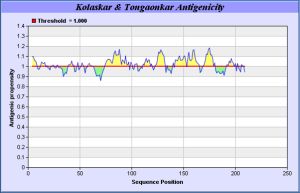 | Fig. 1- Kolaskar and Tongaonkar antigenicity plot showing antibody recognized antigenicity for the T. serrulatus antien 5. |
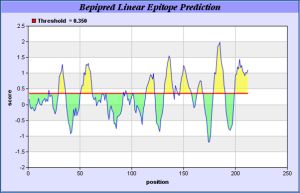 | Fig. 2- Bepipred Linear Epitope Prediction plot showing antibody recognized B-cell epitopes of the T. serrulatus Venom allergen 5 |
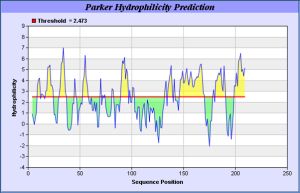 | Fig. 3- HPLC / Parker et al. (1986) hydrophobicity plot of T. serrulatus Venom allergen 5 (antigen 5) |
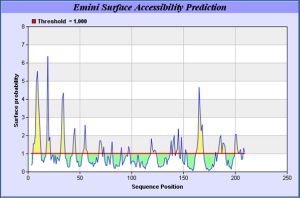 | Fig. 4- Emini Surface Accessibility Prediction plot of T. serrulatus Venom allergen 5 (antigen 5) |
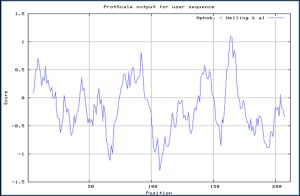 | Fig. 5- Hopp and Woods (1981) hydrophobicity plot of T. serrulatus Venom allergen 5 (antigen 5) |
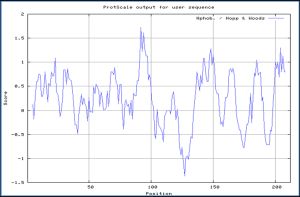 | Fig. 6- Welling et al. (1985) hydrophobicity plot of T. serrulatus Venom allergen 5 (antigen 5) |
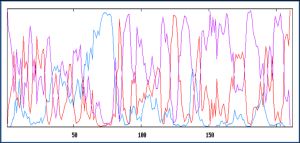 | Fig. 7- Secondary structure plot of the T. serrulatus Venom allergen 5 (antigen 5) *Red: helix, Blue: Sheet, Pink: Coil |
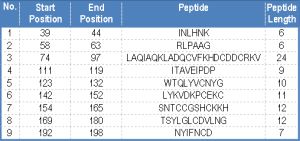 | Table 1- Antigenic epitopes of T. serrulatus Venom allergen 5 |
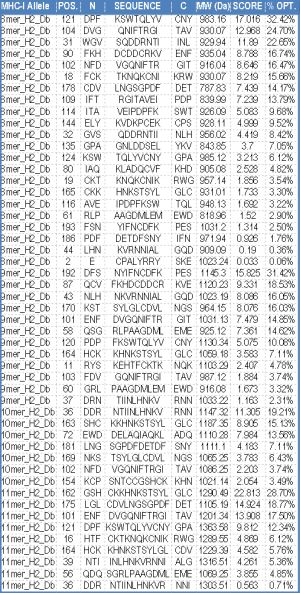 | Table 2- Prediction of MHC class I peptides, from T. serrulatus antigen 5 having C-terminal ends are proteosomal cleavage sites *Optimal Score for given MHC-I peptide binder in Mouse. |
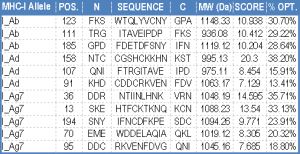 | Table 3- Peptide binders to MHCII molecules of T. serrulatus Venom allergen 5 (antigen 5) *Optimal Score for given MHC-II peptide binder in Mouse. |