


ISSN : 2249-9466
EISSN : 2249-9474



PADGILWAR N.K.1*, ASOLE S.S.2
1B.N.C.O.E, Pusad, MS, India.
2B.N.C.O.E, Pusad, MS, India.
* Corresponding Author : neha.padgilwar@gmail.com
Received : 21-02-2012 Accepted : 15-03-2012 Published : 19-03-2012
Volume : 2 Issue : 1 Pages : 14 - 17
Adv Med Informat 2.1 (2012):14-17
In this topic, the study highlights the development and initial validation of a medical embedded device for individualized care (MEDIC), which is based on a novel software architecture, enabling sensor management and disease prediction capabilities and commercially available microelectronic components, sensors and conventional personal digital assistant (PDA) (or a cell phone). A study of general architecture for a wearable sensor system that can be customized to an individual patient’s needs is carried out. This architecture is based on embedded artificial intelligence that permits autonomous operation, sensor management and inference and may be applied to a general purpose wearable medical diagnostics.
medical embedded system, sensor system.
A. Overview
The rapid advances in patient support and wellness healthcare programs have created requirements for new data sources provided by biomedical sensor monitoring of patients in their home- and work-life. This also introduces a new paradigm for monitoring at the point-of-care requiring the patient information be readily available to any physician at location engaged in the patient’s treatment.
The current proliferation of broadband wireless services, along with more powerful and convenient handheld devices, will enable the introduction of real-time monitoring and guidance for a wide array of patients. Wearable devices focusing on personal health, rehabilitation and early disease detection are now being prototyped. While progress in this area is underway in sensor technology, mobile computing platforms and data transport, barriers to large scale application remain ahead.
B. Potential clinical benefits
Shortened hospital stay for patients under treatment,
Improved patient compliance with therapy exercise regimens and improved recovery.
Improved accuracy in preoperative risk assessment for patients and Improved reliability in assessment of outcomes in clinical trials of response to therapy.
A. Statistical Learning
Patterns in the physiologic and motion signals can be processed with pattern recognition methods used widely in statistical learning, which can be divided into feature extraction and classification. In feature extraction step, features that are indicative of different patient states (patterns) are chosen from the sensor measurement. The features can be
• Temporal: dynamic range (max−min), mean, standard deviation, period, rate variation, correlation between different channels, entropy and signal morphology
• Spectral: energy, power spectral density, moments, entropy, wavelet and eigen components. The temporal features achieves high classification accuracy at low sampling rates while spectral features work better at higher sampling rates. Only features that are relevant to the classification problem should be selected.
B. Decision Making
The patient’s condition classified in a medical diagnosis needs to be transformed into actions in choosing various treatment alternatives. The formalism of the classification techniques in statistical learning do not provide reasoning of the effects to be expected from different treatment alternatives. The constructs from the decision theory can extend the classifiers such as Bayesian networks to include knowledge about decisions and preferences. This extension permits an objective classification of patient’s condition while subjective preferences are incorporated in deciding various treatment alternatives.
C. New Sensing Technologies
A variety of physiological sensors are now miniaturized, some using the latest micro electro-mechanical systems (MEMS) technology and are available for use as small wearable sensors that can be attached to the body or can be embedded in clothing items. These sensors include accelerometers, gyroscopes, magnetometers, piezoelectric sensors, electrocardiogram (ECG), electromyography (EMG), electroencephalography (EEG), pulse rate, blood oxygen saturation (SpO2), blood pressure, respiration, foot pressure, voice, skin conductance, body temperature and location (indoor/outdoor), among others.
D. Local Signal Processing Algorithms for Wearable Sensors
The contextual information describing the patient’s activity, environment and social interaction can enhance the diagnostic power of a wearable sensor system because of the correlations between the physiological and contextual data. Due to the close proximity of the wearable sensors in the WBAN, low-power short-range radio standards such as Bluetooth and Zigbee can be used to link the wearable sensors and the processing unit. Recognizing that it is not always plausible for a sensor to be worn, the same wireless technology can be used to connect home instruments with the wearable systems. Non-portable sensing devices (e.g., weight scales, cameras) are equipped with additional wireless network capabilities to relay captured data.
Based on statistical principles, the Incremental Diagnosis Method (IDM) manages sensing resources by activating or requesting necessary sensors (e.g., through patient interaction) to improve diagnostic certainty. In addition to achieving the required level of certainty with a minimum set of sensors, other conventional clinical data sources that are not conveniently wearable, such as a weight scale, blood pressure cuff, lab test, imaging, etc., can be included in the medical diagnosis process. Combined with IDM, MEDIC can be used to monitor the patient remotely and diagnose patient conditions with minimum sensor usage on the patient body while yet selecting the optimal available sensor set.
The Incremental Diagnosis Method (IDM) is an iterative process with an ability to adjust sensors to achieve the diagnostic resolution level and certainty requirements.
A. Diagnostic Resolution Levels
When diagnosing a medical condition, successively more refined levels of information are typically acquired. The concept of diagnostic resolution levels can be envisioned as a tree structure, in which the root corresponds to the least informative state and the leaves describe the patient state in detail. As such, the root state may only require a low-resolution sensor for detection, while the leaf states typically require high resolution sensors.
B. Algorithm Overview
The IDM algorithm as shown [Fig-3.2] has three inputs: A diagnostic resolution level query,A minimum acceptable certainty threshold for detection and user action that results in acquisition of new sensor inputs Available sensors can include a set of sensors ranging from full-time (e.g., an accelerometer) and part-time (e.g., a knee sensor) wearable sensors to standalone instruments such as a weight scale. The wearable system continuously acquires data from available sensors (i.e., all full-time and some part-time wearable sensors that are present) and infers the user state (e.g., ambulation) using the real-time inference engine. The system outputs are a report of the patient state and sensor requests.
There are two feedback loops in the system. The first one occurs when the system has control of the part-time sensors, but does not always include these sensors in the analysis to conserve system energy. If needed, the IDM could activate these sensors automatically to acquire data for the next diagnostic iteration. The second loop involves a user activating the part-time sensors or data acquisition from standalone instruments. This loop allows the utilization of sensors and instruments (e.g., blood-pressure monitor, weight scale, knee sensors, etc.) that are inconvenient or impossible to wear full-time, though occasional use can greatly enhance detection of a particular user state.
C. Inference Engine
The inference engine, which is hosted on the wearable system, consists of three components:
• Feature Extraction,
• Naїve Bayes Classifier and
• Sensor Selection. Each component is described next
i. Feature Extraction
The feature extraction step summarizes the time domain data from each sensor into a vector of sensor feature variables F = {F1, · · · , Fn} for the Bayes classifier (see below). For patient ambulation in steady states, sensor readings in the time domain can be processed to extract frequency spectral components by Fourier transform.
ii. NaÑ—ve Bayes Classifier
In this step, the inference engine uses a naÑ—ve Bayes classifier model to infer patient state C probabilities given the feature vector F from the previous step. Due to the “naÑ—ve†assumption – if the patient state C is known, each feature Fi is conditionally independent of every other feature Fj for j≠i – the conditional probability of the feature vector given the patient state can be expressed as a simple product of the conditional probabilities of each feature variable given the patient state, i.e., p (F|C) = âˆâ¿i=1 p (Fi|C). Likewise, the marginal probability of the feature vector can be expressed a simple product of the prior marginal probabilities of each feature, i.e., p (F) = âˆâ¿i=1 p (Fi). As such, the conditional distribution of the patient states can be expressed as shown below.
iii. Sensor Selection
In the final step, the inference engine determines if the diagnosis meets the required level of accuracy, as required at the outset by the user. If not, a decision is made as to which of the higher-cost sensors to include in the next processing iteration. A utility function guides the suggestion of actions that are recommended to the user, such as inserting/removing part-time wearable sensors, or the use of a standalone instrument.
The MEDIC system architecture has been developed to support the local sensing, signal processing and autonomous decision support The MEDIC system architecture consists of three network tiers in [Fig-4.1] .
The system relies on the established Internet network infrastructure in the first tier and then standard, ubiquitous wireless or GPRS or cellular data technologies (Wi-Fi or general packet radio service (GPRS)) in the second tier. The first two network tiers connect the personal server and the servers at hospitals or clinics.
The third network tier consists of a WBAN of wearable sensors using off-the-shelf commercial Bluetooth radio components. Although the WBAN can also be implemented with other low-power wireless technologies such as ZigBee, Bluetooth technology is a likely candidate for early adoption by the medical community.
A. Hardware
The MEDIC system hardware is based on standard commercial components that offer a path for low cost and ubiquitous deployment.
i. Personal server
The personal server in our architecture can be any standard cell phone or PDA equipped with Bluetooth. Among the many such devices that are currently available (e.g., Nokia N80, HP IPAQ, Sharp Zaurus, etc.)
ii. PDA: Personal Digital Assistant
A small computer that literally fits in the palm of your hand.
iii. Wearable Sensors
For the wireless wearable sensors, we also use a commercially available Bluetooth development board for its simple application programming interface (API), compact form factor and low power consumption.
B. Software architecture of Medical Embedded system
The main part of the software [Fig-4.5] is a multi-threaded device server that facilitates the connection between wireless sensing devices and client services, such as local signal processing, a graphical user interface (GUI) for patient interaction and data logging. These individual client programs are connected to each other and the device server via TCP/IP sockets, enabling reliable, language-independent communication across heterogeneous hardware in different locations.
In order to support patients who do not own a PC but have land line phone service, interfaces to multiple modem-based solutions have been established. Depending on the glucose meter being used by the patient, a meter-specific modem device that plugs into a phone jack is available to the patient. These commercially available solutions are generally only compatible with a limited number of glucose meters.
Several extensions of this system and validation are planned. First, development is proceeding on feature extraction strategies covering the temporal, spectral and correlation features. The Bayesian inference model is also being extended with a probabilistic transition model to enable data smoothing and to minimize anomalies in state transitions by including time dependency in the patient state sequences.
The MEDIC system introduces few primary innovations: An infrastructure for the rapid integration of multiple standard commercial sensor devices into a body area wireless network providing real-time data acquisition and local data processing from the wearable sensors, an embedded inference engine hosted locally on the personal server that can guide the selection of sensor inputs to optimize the certainty of diagnosis while minimizing the number of required sensors and an autonomous mechanism by which the patient (via the personal server’s GUI) and medical personal (via the network) can interact with the system for data visualization or system configuration.
[1] Wu W.H., Bui A.A.T., Batalin M.A., Au L.K., Binney J.D. and Kaiser W.J. (2008) Artificial Intelligence in Medicine.
» CrossRef » Google Scholar » PubMed » DOAJ » CAS » Scopus
[2] Wu W.H., Bui A.A.T., Batalin M.A., Liu D. and Kaiser W.J. (2007) IEEE Transactions on Information Technology in Biomedicine.
» CrossRef » Google Scholar » PubMed » DOAJ » CAS » Scopus
[3] Farringdon J., Nashold S. (2005) Continuous body monitoring. Springer Lect. Notes Computer Science.
» CrossRef » Google Scholar » PubMed » DOAJ » CAS » Scopus
[4] Roozbeh Jafari andre Encarnacao, Azad Zahoory, Foad Dabiri, Hyduke Noshadi and Majid Sarrafzadeh. Second Annual International Conference on Mobile and Ubiquitous Systems: Networking and Services.
» CrossRef » Google Scholar » PubMed » DOAJ » CAS » Scopus
[5] Zhang M.J., Sabharwal C.L., Tao W., Tarn T.J., Xi N., Li G. (2004) IEEE Transactions on Nanobioscience, 3(4).
» CrossRef » Google Scholar » PubMed » DOAJ » CAS » Scopus
[6] Xu W., Vijaykrishnan N., Xie Y. and Irwin M.J. (2004) 14th ACM Great Lakes symposium on VLSI.
» CrossRef » Google Scholar » PubMed » DOAJ » CAS » Scopus
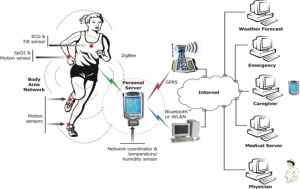 | Fig. 1.1- Ubiquitous Health Monitoring Using WBAN |
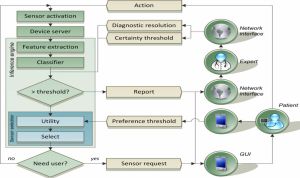 | Fig. 3.2- Architecture overview of the Incremental Diagnosis Method. |
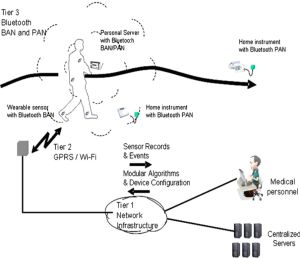 | Fig. 4.1- System architecture depicting three tiers of network. |
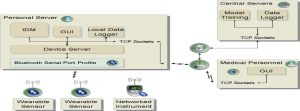 | Fig. 4.5- Software Architecture |