


ISSN :
EISSN :



POURANIK M.1*, SWAMI P.2, BHUMARKAR M.3
1Department of Zoology, Mata Gujri College, Jabalpur- 482 004, MP, India.
2CHL APOLLO Hospital, Jabalpur- 482 004, MP, India.
3Department of Zoology, Mata Gujri College, Jabalpur- 482 004, MP, India.
* Corresponding Author : drmanjusha123@gmail.com
Received : 21-01-2012 Accepted : 24-07-2012 Published : 16-08-2012
Volume : 1 Issue : 1 Pages : 1 - 3
World Res J Diabetes 1.1 (2012):1-3
Background- Urinary tract infection defines a condition in which the urinary tract is infected with a pathogen. Women with diabetes probably have a higher frequency and serious complications of Urinary Tract Infections, especially after menopause, when hormonal changes increase the risk of developing an infection in urethra or bladder. Methodology- Urine specimens were plated on MacConkey agar and Nutrient Agar Plates and incubated at 37oC for 18-24 hours. Isolated colonies from significant plates were identified using standard bacteriological procedures. Results- Total 85 women with diabetes were studied. 35 (41.1%) subjects showed a significant colony count. Pseudomonas aeruginosa were found in 6 cases (14.2%).Out of these 6 cases 2 were symptomatic (33.3%) whereas in 4 cases Asymptomatic Bacteriuria condition were observed (66.6%).In all the cases patients were of prolong diabetic and elderly women population. Increased blood glucose level increases the risk of UTI. Urinary tract infection with Pseudomonas aeruginosa found mostly in elderly or postmenopausal population in starting 5 years of diabetes. Conclusions- Asymptomatic Bacteriuria is the major problem in diabetic women. Postmenopausal condition & increased sugar level may become one of the major causes of infection. Major Advances in the Field- In the changing scenario other than E.coli various other micro organisms such as Candida, Pseudomonas, Enterobacteriaceae are also found in etiology of UTI. Scanty available information regarding pathogenesis of UTIs caused by Pseudomonas aeruginosa is an important bottleneck in developing effective preventive approaches.
Bacteriuria, Diabetes, Pseudomonas aeruginosa.
Diabetes mellitus is a metabolic syndrome characterization by an inappropriate elevation of blood glucose as a result of relative or absolute lack of insulin. Diabetes mellitus has long term effect on genitourinary system and diabetics are more prone to Urinary tract infections [1] . Both Symptomatic & Asymptomatic Urinary Tract Infections are reported to occur with increased frequency in women with diabetes [2] . Urinary tract infection defines a condition in which the urinary tract is infected with a pathogen causing inflammation which is a common distressing & occasionally life threatening condition [1] .
Women with diabetes probably have a higher frequency and serious complications of Urinary tract infections [3] . Most of the UTIs are Asymptomatic especially in women. Previous studies have shown that the prevalence of Asymptomatic Bacteriuria is three times higher in Diabetic women than non Diabetic women [4] . Infections that are clinically apparent are called symptomatic infection a burning sensation or a sense of urgency in urination, temporary bladder incontinence; foul-smelling or bloody urine may be signs of a UTI. If the infection advances to kidneys, it may develop permanent kidney damage. For some elderly women, UTIs recur frequently, interfering with daily activities and causing ongoing discomfort [3,5] .
Asymptomatic infections go unnoticed by the patient himself due to lack of any clinical symptoms and signs. Asymptomatic infections are equally important as symptomatic infections in regards to health hazard. Bacteriuria is a condition in which bacteria remain and multiply in urine, which is the second most common problem in developing countries [5] . Urinary tract infection (UTI) accounts for considerable morbidity among adult women. Women tend to get them more often because their urethra is shorter and closer to the anus than in men. Menopause also increases the risk of a UTI when hormonal changes increase the risk of developing an infection in urethra or bladder [2] .
Enterobacteriaceae and gram-negative organisms, such as E. coli, Pseudomonas aeruginosa, Gram-positive organisms including Enterococcus spp. and coagulase-negative staphylococcus other than Staphylococcus saprophyticus may be isolated more frequently from patients with asymptomatic compared with symptomatic infection [5] . The epidemiology and pathogenic mechanisms of uropathogenic E. coli have been extensively studied, little is known about the pathogenesis of UTIs caused by other organisms like Pseudomonas aeruginosa. Scanty available information regarding pathogenesis of UTIs caused by P. aeruginosa is an important bottleneck in developing effective preventive approaches [6] .
The objective of the study was to investigate the frequency of uropathogen in different age groups of diabetic women & its relation to duration of diabetes. The present study also focuses on the importance of p. aeruginosa as etiologic agent in postmenopausal age group with asymptomatic conditions.
Total of 85 diabetic women of age 20-90 attending Marble City Hospital Jabalpur & CHL Apollo Hospital Jabalpur for blood sugar estimation during December 2011 were included in this study. The clinical history was taken according to questionnaire. The blood sugar level of the patients was estimated in the routine biochemistry laboratory. Midstream urine was collected from each patient in a sterile container. Urine specimens were plated on MacConkey and Nutrient Agar plates, Plates were incubated for 18-24 hours at 37 o C, the number of colony Forming units/ml (c.f.u./ ml) was counted and urine samples giving 105 c.f.u./ ml of a single potential pathogen or two potential pathogens were considered significant. Isolated colonies from significant plates were identified using standard bacteriological procedures. Samples were processed using the standard microbiological procedures such as gram staining & different biochemical tests.
85 women with diabetes were taken in the present study. 35 (41.1%) subjects showed a significant colony count & considered for Urinary Tract Infection after repeating sampling 2nd time. UTI with Pseudomonas found only at the 51-60 (postmenopausal) age group. [Table-1] Enterobacteriaceae bacteria found in most of the cases 29(69.04%) gram positive cocci was seen in 7(16.27%) cases and Pseudomonas aeruginosa were found in 6 cases (14.2%). [Table-2] Out of six Pseudomonas positive patients four shows asymptomatic bacteriuria (66.6%) and rests were symptomatic (33.3%). Table shows that the increased blood glucose level increases the risk of Pseudomonas Infection. Pseudomonas Infection seen mostly in elderly or postmenopausal population in their starting 5 years of diabetes. Pseudomonas was found in 6 cases (14.2%).
The risk of Urinary Tract infection is higher and is serious clinical problem in diabetic women. Both Symptomatic and Asymptomatic bacteriuria are reported to occur with increase frequency [7] . The risk of UTI was higher with increasing duration of diabetes. Poor glycemic control enhances the chances of UTI as reported by Patel, et al [8] . After 14 years prospective study about the complications
of UTI he has reported 31.4% of patients with severe diabetes as acute and chronic UTI similarly Baloch et, al. reported 61% patients had poor glycaemic control [2] .
In the present study Pseudomonas aeruginosa was observed in 6 postmenopausal women with uncontrolled glycaemic condition. R mittal, et al. reported mortality and morbidity associated with P. aeruginosa included UTIs remain significantly high. It was observed in our study that out of these 6 patient 4 was showing asymptomatic condition [6] . Previous reports focused that catheterization especially in older population is one of the common factor to allow bacteria colonization. E. coli, Proteus mirabilis, Pseudomonas, Klebsiella pneumonia are catheter associated uropathogens. In our study it was observed that these uropathogens are normally found in diabetic patients whether the condition were symptomatic or asymptomatic. Catheterization was not the cause of infection. In case of E. coli the epidemiological, experimental and clinical studies have established the role of multiple virulence factors of E. coli. However there is scarcity of literature in relation to pathogenesis of UTI caused by P. aeruginosa. The present study highlights the importance of P. aeruginosa as uropathogens in postmenopausal women so that proper antimicrobial therapy should be develop to treat such cases.
Good glyceamic control may reduce the prevalence of UTI [9] . uncontrolled sugar was the prime cause to develop ASB we have also observed that poor glyceamic control was one of the major causes of ASB especially in women [10] .
Bacteriological investigation revealed the involvement of gram negative organisms commonly Causes UTI such E. coli Klebsiella & Proteus spp. we have also observed the same E. coli (27.9%), Klebsiella (13.95%), Staphylococcus (16.27%), Citrobacter (11.6%)etc [11] .
Increased blood glucose level increases the risk of Pseudomonas aeruginosa Infection. Risk of clinically apparent bacteriuria is higher in postmenopausal women. Pseudomonas aeruginosa is a common causal organism of asymptomatic as well as symptomatic UTI. Risk of Pseudomonas aeruginosa infection is higher in the early years of diabetes.
This work was conducted under financial support of Madhya Pradesh Council of Science & Technology, Bhopal (No. 4568/CST/BTAC/10Dt 31/3/2010). We extend sincere thanks towards the authority.
[1] Sibi G., Devi A., Fouzia K. and Patil B. (2011) Research Journal of Microbiology, 6(6), 543-551.
» CrossRef » Google Scholar » PubMed » DOAJ » CAS » Scopus
[2] Baloch G., Jaffery M., Madhudas C., Devrajani B. and Shah S. (2011) Professional Med. J., 18(3), 466-469.
» CrossRef » Google Scholar » PubMed » DOAJ » CAS » Scopus
[3] Eligius F., Lyamuya S., Ewaldo Komba V. and Haule M. (2011) African Journal of Microbiology Research, 5(6), 683-689.
» CrossRef » Google Scholar » PubMed » DOAJ » CAS » Scopus
[4] Yohanes A. (2011) Australian Family Physician, 40(10).
» CrossRef » Google Scholar » PubMed » DOAJ » CAS » Scopus
[5] Nicolle E. (2003) Infect. Dis. Clin. N. Am., 367-39417.
» CrossRef » Google Scholar » PubMed » DOAJ » CAS » Scopus
[6] Mittal R., Agrawal S., Sharma S., Chhibber S., Harjai K. (2009) Journal of Infection and Public Health, 2, 101-111, 778 -1783.
» CrossRef » Google Scholar » PubMed » DOAJ » CAS » Scopus
[7] Hale T. Kivanc S., Ayse T., Sevesen K., Mustafa K., Baris P. and Hande A. (2008) Jpn. J. Infect. Dis., 61(3), 236-8.
» CrossRef » Google Scholar » PubMed » DOAJ » CAS » Scopus
[8] Petel J.C. (1989) Indian Med. Sci., 43(7), 177-83.
» CrossRef » Google Scholar » PubMed » DOAJ » CAS » Scopus
[9] Brauner A., Foldin U., Hylander B. and Ostenson C. (1993) Diabet Med.,10(6), 550-4.
» CrossRef » Google Scholar » PubMed » DOAJ » CAS » Scopus
[10] Jha B., Singh L.,Yadab Y. and Sanjana R. (2009) Kathmandu University Medical Journal, 7(2), 157-61.
» CrossRef » Google Scholar » PubMed » DOAJ » CAS » Scopus
[11] Bova J., Potter J., arevalos E., Hopens T., Goldstein H. and Radwin H. (1985) J. Urol.,133, 375-8.
» CrossRef » Google Scholar » PubMed » DOAJ » CAS » Scopus
 | Table 1- Causal Organism of Bacteriuria |
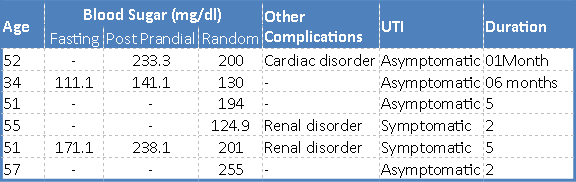 | Table 2- Case Report of patients showing Pseudomonas Infection |