


ISSN : 0976-7061
EISSN : 0976-707X



GEETHA K.N.1*, PATEL S.C.2, CHAVAN L.N.3, CHARUSHILA SHINDE4
1MGM Medical college, Navi Mumbai, MS, India.
2Adani Institute of Medical sciences, Bhuj, Gujarat, India.
3MGM Medical college, Navi Mumbai, MS, India.
4MGM Medical college, Navi Mumbai, MS, India.
* Corresponding Author : geetha.dr@gmail.com
Received : 11-03-2012 Accepted : 09-04-2012 Published : 01-06-2012
Volume : 3 Issue : 1 Pages : 16 - 18
J Clin Res Lett 3.1 (2012):16-18
DOI : http://dx.doi.org/10.9735/0976-7061.3.1.16-18
Conflict of Interest : None declared
Sexual dimorphism in digit ratio was first reported by Ecker in 1875. This observation was reestablished by a number of researchers later on. But most of these studies are conducted in adult age group. Aim of this study is to establish the presence of sexual dimorphism in all age groups. Objectives- ï‚· To find out whether 2D:4D (2nd to 4th digit ratio) shows sexual dimorphism in both right and left digit ratios measuring dermatoglyphic lengths. ï‚· To find out whether sexual dimorphic pattern of 2D:4D is present in all age groups. Design- A transverse study Study group: Considered 3 sample groups: i. 64 children (34 boys and 30 girls) in 3-16 yrs. group ii.100 students (50 boys and 50 girls) in 17-21 yrs. group iii.100 subjects (50 males and 50females) in >25 yrs. group Method- Dermatoglyphic length of 2nd and 4th digits of both hands were taken and their ratios calculated. Conclusion- This study concludes that there is sexual dimorphism in 2D:4D ratio, which is more pronounced in right hand ratio than left hand ratio. The average digit ratio in females was higher than the average male digit ratio in all age groups. This once again highlights the fact that the digit ratios are related to in-utero concentrations of sex hormones and this sexual dimorphism remains irrespective of the age. Further study with large population and/or longitudinal study is required to provide more concrete base for this analysis.
Digit length, digit ratios, Sexual dimorphism, 2D:4D ratio, Dermatoglyphic length.
Hand analysis and palmistry have intrigued humans throughout history. Perhaps earliest interest in hand reading occurred when cave dwellers left their hand prints on cave walls 12,000 years ago. Since writing was invented,thousands of documents have been created detailing hand analysis techniques and palmistry. In India “SAMUDRIK SHASTRA†adorned supreme position as a form of science during ancient period. ‘ Samudrik Shastra ’ literally means ‘ocean of knowledge’, of which Palmistry forms a subsection. Palmistry deals with morphological features of the hand,for example the size, shape, segmental lengths, birth marks and other fine lines forming symbols. As per palmistry every hand is a map of life and every part of hand from the finger tips to the wrist represents precisely the constitutional nature and life history of the person with events like major accidents, diseases or calamities .In modern science two aspects of human hand have drawn attention for observation and analysis.
1. Dermatoglyphic ridge pattern and its quantification.
2. Finger lengths and their proportions
Pioneer research in modern science related to finger length pattern was first reported in 1875 by Ecker [1] . Studies reported from western countries suggest a negative relation between 2D:4D ratio with testosterone levels and positive relations with estrogen [2] . This present study is an attempt to find sexual dimorphism in digit ratios (2D:4D) .
In the human hand second digit (index finger) and fourth digit (ring finger) have been shown to demonstrate a pattern of approximate symmetry around the axis of the third digit (middle finger). The ratio of the index finger to the ring finger ie. 2D:4D shows sexual dimorphism. The digit ratio would be 1.00 if the index and ring fingers of the same length and greater than 1.00 if the index finger is longer than the ring finger. Males generally have a 2D:4D ratio below 1.00 and females generally have a 2D:4D ratio about 1.00 or high digit ratio [3-6] . There is evidence that sex differences in 2D:4D ratio arise from in-utero concentrations of sex hormones, with a low 2D:4D(male typical ratio) been positively related to prenatal testosterone while a high 2D:4D(female typical ratio)is positively associated with prenatal estrogen exposure. [7,8] .
There are three different models of digit lengths. Accordingly three possible methods of measurements are generally followed. Factors contributing to the length of digits are length of phalanges, joint spaces between the bones i.e. Interphalangeal and metacarpophalangeal joint and pulp spaces at tip.
It is the length from the dorsal aspect of the knuckle to the tip of the finger. This includes the heads of metacarpals, phalanges and soft tissues overlying it.
It is the length from the base of the proximal phalanx to the tip of the distal phalanx of the digit, measurements taken from X-rays of hand.
i) By print method
ii) By direct measurement using vernier caliper.
It is the length from proximal crease(c) at the base of the finger to the tip of the finger (t) on the palmar aspect of the hand. Majority of the research works undertaken so far have used this model as the method of digit measurement including this present study.
Aim of this study is to establish the presence of sexual dimorphism in all age groups.
• To find sexual dimorphism in 2D:4D digit ratio at different ages.
• To confirm whether sexual dimorphism is present in all age groups.
• To confirm whether sexual dimorphism is more significant in Right or Left hand ratios.
Present study is a transverse study conducted in MGM Medical college, Navi Mumbai. A total number of 264 subjects were considered for this study and they were divided into three groups, 3-16 yrs., 17-21yrs. and >25 yrs. Parameters included were age, sex, length of second digit and fourth digit of both hands. 2D:4D ratios were calculated. Analysis was done with SPSS software programs. Prior informed consent was obtained from each subject for participation in the program. They were briefed about the procedure for full co-operation. Exclusion criteria for the study were those who had deformed digits and history of injury to digits.
The participants were asked to keep their hands supine on the table surface with the palm facing up and the digits straight in the same plane and fingers opened in a posture of ease (not kept together tight under artificial pressure). Care was taken to ensure that details of major creases could be seen on the hands by removing finger ornaments. Length of each digit was measured on the ventral aspect of hand from the proximal crease to the tip of the finger. In most of the subjects there were two creases at the base of ring finger, of which the most proximal crease was chosen for the measurement. The length was measured by using a vernier caliper sensitive to 0.01cm with the pointers of the caliper just touching the middle point of proximal crease and tip of the finger.
This study is a transverse study on a small sample with all subjects being Indians. In this study the female average 2D:4D was higher than male average 2D:4D in all age groups. This difference was more pronounced in right digit ratios than left digit ratios. This was previously established by a number of researchers [1-5] . It has been established by Garn SM 1975 [2] and Malas MA 2006 [3] that adult metacarpophalangeal rankings are attained by 7th intrauterine week and near adult bone to bone proportions are attained by 13th intrauterine week.
Present study showed sexual dimorphism in 2D:4D in age groups 17-21 yrs. and >25 yrs. Results were statistically significant in these groups. In age group < 16 yrs result was not statistically significant. The reason could be (i) small sample size (ii) wide range of age group ie. age between 3-16 yrs.
Current study ratios were compared with other studies [table] . This comparison clearly shows that there could be variations in absolute digit length ratios among different races. The difference in actual figures of ratios is possibly because of method followed and sample size. Some researchers followed the direct measurement as is for the current study, where the ratios are comparable. While others followed photocopy or x-ray method where the ratios are variable , but a distinct dimorphism is apparent in all methods. The current study showed Right hand 2D:4D (c-t) ratio range in different age groups 0.961 to 0.978 in male and 0.966 to 0.995 in female. We tried to find whether an arbitrary figure could be applied to define male pattern and female pattern. On best observations available 0.980 was arbitrarily selected to distinguish between male female ratio ie. ≤ 0.980 as male ratio and > 0.980 as female ratio.
This study concludes that there is sexual dimorphism in 2D:4D ratio, which is more pronounced in right hand ratio than left hand ratio. The average digit ratio in female was higher than the average male digit ratio in all age groups. This once again highlights the fact that the digit ratios are related to in-utero concentrations of sex hormones and this sexual dimorphism persists irrespective of the age. Further study with large population and/or longitudinal study is required to provide more concrete base for this analysis.
• 2D:4D- Second to fourth digit length ratio.
• c-t- Crease to tip length.
[1] Fleur R. Cattrall, Beverley J. Vollenhoven, Gareth C. Weston (2005) Journal of Fertility and Sterility, 84(6).
» CrossRef » Google Scholar » PubMed » DOAJ » CAS » Scopus
[2] Lutchmaya S., Baron-Cohen S., Raggatt P., Knickmeyer R., Manning J.T. (2004) Early Human Development, 77, 23-28.
» CrossRef » Google Scholar » PubMed » DOAJ » CAS » Scopus
[3] Garn S.M., Burdi A.R., Babler W.J., Stinson S. (1975) American Journal of Physical Anthropology, 43, 327-332.
» CrossRef » Google Scholar » PubMed » DOAJ » CAS » Scopus
[4] Manning J.T., Scutt D., Wilson J., Lewis-Jones D.I. (2002) Human Reproduction, 13, 300-3004.
» CrossRef » Google Scholar » PubMed » DOAJ » CAS » Scopus
[5] Manning J.T. (2002) Digit ratio. New Brunswick.
» CrossRef » Google Scholar » PubMed » DOAJ » CAS » Scopus
[6] Manning J.T., Barley L., Walton J., Lewis-Jones D.I., Trivers R.L., Singh D., Szwed A. (2000) Evolution and Human Behaviour, 21, 163-183.
» CrossRef » Google Scholar » PubMed » DOAJ » CAS » Scopus
[7] Windy M., Brown Melissa Hines, Brioy F., Fane S. (2002) Mark Breedloves, 42, 380-386.
» CrossRef » Google Scholar » PubMed » DOAJ » CAS » Scopus
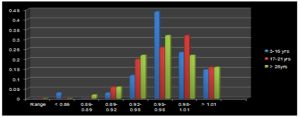 | Chart 1- Sexual dimorphism in 2D:4D Male (right) |
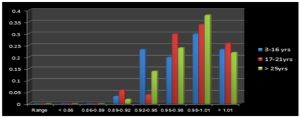 | Chart 2-Sexual dimorphism in 2D:4D Female (right) |
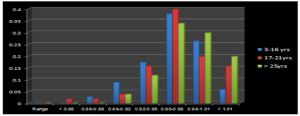 | Chart 3- Sexual dimorphism in 2D:4D Male (left). |
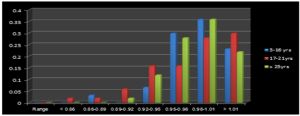 | Chart 4- Sexual dimorphism in 2D:4D Female (left). |
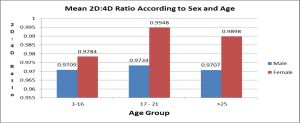 | Chart 5- Mean 2D:4D Ratio According to Sex and Age. |
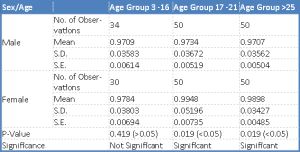 | Table 1-Descriptive Statistics for 2D:4D Ratio According to Sex and Age |
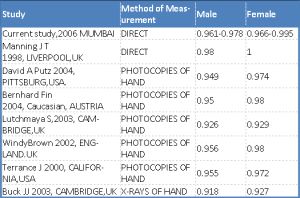 | Table 2- Comparison of current study with other studies-RIGHT HAND |